Chicago Fed: Midwest ag land
values increased in first of ’18
By DOUG SCHMITZ
Iowa Correspondent
CHICAGO, Ill. — The Federal Reserve Bank of Chicago has reported
Midwest farmland values have increased in the first quarter of this year, showing
signs of stabilizing and remaining unchanged from a year ago.
That’s according to recent survey responses of 181 agricultural
bankers from the Seventh Federal Reserve District, which includes Illinois,
Indiana, Iowa, Michigan and Wisconsin.
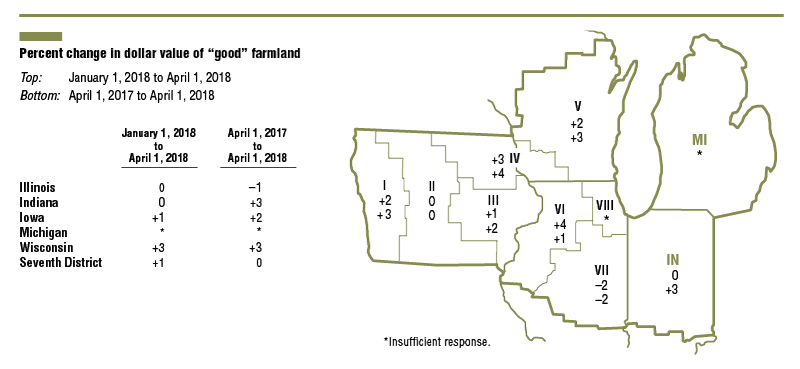
“On average, ‘good’ farmland values in the first quarter of 2018
rose 1 percent from the fourth quarter of 2017,” said David Oppedahl, Chicago
Fed senior business economist, who conducts the district’s quarterly surveys.
This increase in district ag land values marked the fifth quarter
in a row without a decline in such values. “Illinois and Michigan (the latter
based on a handful of responses) were the only district states to experience
year-over-year decreases in farmland values,” he explained.
While farmland markets saw supply rising a bit, demand and sales
slipped, he added. “There was an increase in the amount of agricultural land
for sale during the most recent winter and early spring relative to a year ago,
as 27 percent of the responding bankers reported more farmland was up for sale
in their areas, and 23 percent reported less.”
With 18 percent of the survey respondents reporting higher demand
to purchase farmland and 20 percent reporting lower demand, Oppedahl said there
was almost an even split among those who perceived a shift in interest on the
part of buyers in the three- to six-month period ending with March 2018,
relative to the same period ending March 2017.
In addition, with cash rentals making up 80 percent of district
agricultural land operated by someone other than the owner, changes in their
terms are a key indicator of agricultural conditions, he said.
“Cash rental rates for farmland in the district decreased 5
percent for 2018 relative to 2017 – the smallest decline in four years.” In
fact, for 2018, average annual cash rents to lease farmland were down 5 percent
in Illinois, 3 percent in Indiana, 6 percent in Iowa, 3 percent in Michigan and
7 percent in Wisconsin, he said.
“There seemed to be enough farmers willing to take on more acres
to plant, such that cash rents did not fall as much as they would have
otherwise,” he said. “Meanwhile, other farmers quietly ended their rental
contracts, even defaulting on payments to landowners, in some cases.”
Released May 15, the survey results also showed 2018’s real cash
rental rates were 26 percent below their level in 1981, while real farmland
values were still 67 percent above their 1981 level.
“Hence, the implication is that relatively stronger demand to own
farmland than to lease it has kept farmland values from falling as much as the
earnings potential of farmland (represented by cash rental rates),” Oppedahl reported.
In March 2018, he said corn and soybean prices were about the
same as a year ago, according to data from the USDA; however, the five-year
drops in real corn and soybean prices were 54 and 37 percent, respectively.
“Since these price decreases would have resulted in greater
declines in crop revenues than observed in cash rents over the past five years
(all else being equal), farm operations needed productivity gains through
higher yields and cost-cutting measures in order to preserve working capital
and maximize cash flows,” he said.
In addition, district agricultural credit conditions tightened
further during the first quarter of 2018.
“Once more, repayment rates for non-real estate farm loans were
down from a year ago, and renewals and extensions of these loans were up from a
year earlier,” he said. “Demand for non-real estate loans in the first quarter
of 2018 was higher than a year ago, while the availability of funds to lend was
somewhat lower.”
Chris Hurt, Purdue University professor of agricultural
economics, noted that Midwest land values adjusted downward in 2014, 2015 and
2016.
“In 2017 and 2018, they have exhibited more stability or
bottoming,” he said. “Generally, the amount of land available for sale has been
lower than normal as the U.S. Fed kept interest rates low.”
Hurt said families that owned farmland could earn nearly 3
percent from cash rent and CDs had lower returns than cash rent, adding that CDs
are a common alternative way to invest capital for farm families.
“Times are changing,” he said. “Global weather has been less than
ideal in 2018. Dropping production and world economic growth is supporting
strong usage. As a result, excess grain stocks are declining and farm prices
are improving. Inflation is likely to continue to pick up, and this will
initially support farmland values.”
Hurt said farmland buyers also generally believe that in the
longer run, basic food production will be a favorable industry.
“The current outlook for operating margins on Midwest grain farms
are expected to improve in 2018 and again in 2019, suggesting an upward
trajectory for the grain-farm economy in recovery from extreme lows,” he said.
“Operating margins in 2018 are still negative, which means they
will not cover all of the overhead costs associated with machinery ownership
and providing a reasonable labor return, but they are improved from the past
four years.”
Moreover, a headwind to further increases in farmland values will
be higher costs of production and higher interest rates. “Higher costs are
almost universal in 2018: machinery, fertilizer, fuel, chemicals, labor and
interest rates. The 10-year Treasury yield has now pushed higher than the 3 percent
cash rent return,” he said, “and may provide incentives for some additional
families to sell farmland.
“In addition, a 3 percent, 10-year Treasury yield is consistent
with a real estate loan rate at commercial banks in the Chicago Fed district of
about 5.5 percent, the highest level since 2011. Higher interest rates will
encourage more farmland sellers and discourage some buyers.”
|