Tri-state ag
directors review Lake Erie Basin water work
By CELESTE BAUMGARTNER
Ohio Correspondent
CLEVELAND, Ohio — Agricultural directors from Ohio, Michigan and
Indiana talked about efforts to improve water quality in the Western Lake Erie
Basin (WLEB) at the Midwest Assoc. of the State Departments of Agriculture’s
annual meeting.
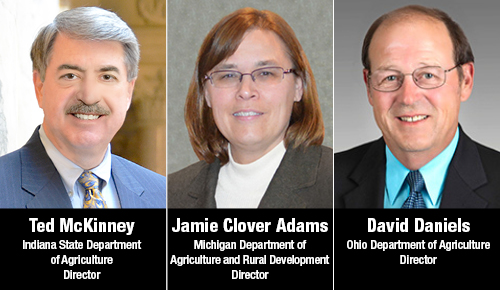
Ohio Department of Agriculture (ODA) Director David Daniels,
Michigan Department of Agriculture and Rural Development (MDARD) Director Jamie
Clover Adams and Indiana State Department of Agriculture Director Ted McKinney
each talked about efforts to protect and preserve groundwater resources in
their states.
Michigan
“The Western Lake Erie Basin is a complex biological system, and
the health of the lake is affected by many things, wastewater treatment, septic
systems and food production,” Clover Adams said. “No one thing that is
completely responsible for what we see, but we all need to do our part.”
Michigan has installed 23,000 acres of buffer strips and the
state calculates it has reduced the total phosphorous load in the WLEB by 20-30
percent. The Michigan Agriculture Environmental Assurance Program (MAEAP),
begun in 1999, accomplished that in part, Clover Adams said.
MAEAP is a voluntary environmental stewardship program in which
local technicians help farmers identify environmental risks, she said. They
walk the farm and figure out which management practices will reduce risks in each
field. MDARD then verifies the farm.
Also, there are only 17 large animal operations in Michigan’s
part of the basin and longstanding signs show that manure can safely be spread
safely there in winter, Clover Adams explained. They have environmental permits
that require six months of manure storage beginning Dec. 1 each year, so they
have no real need to spread in winter.
“But it does happen sometimes, and the data shows us in the last
two years only four of these facilities found it necessary to spread,” she
explained. “It was done on fields that science and research indicates are least
likely to have runoff.”
Ohio
Daniels said under the leadership of Gov. John Kasich water quality
will continue to be the ODA’s No. 1 issue.
“In Ohio, we have implemented one of the first fertilizer
certification programs in the United States,” he added. “Anyone who applies a
nutrient on 50 or more contiguous acres must be certified by September 1 of
this year. So far we have certified almost 16,500 farmers in Ohio.”
ODA has introduced two new programs. First is the Ohio
Agricultural Stewardship Verification Program, a pilot certification for
farmers who protect farmland and natural resources by implementing best
management practices on their farms.
The second program is the Ohio Applicator Forecast, designed to
help nutrient applicators identify times when the weather-risk for applying is
low. The National Weather Service creates the risk forecast.
Also, nearly 54,000 acres now have cover crops growing on them in
winter, Daniels said. Ohio has gone from just a few to almost 900 controlled
drainage structures.
Farmers have built 50 new manure storage structures; almost
34,000 acres of farmland has been converted to filter strips and riparian
buffer near creeks and streams. Another 6,800 acres have been converted to
wetlands.
Indiana
Next, McKinney explained Indiana does not have shoreline on the
WLEB, but it has four watersheds that feed into it. Six northeastern Indiana
counties feed into the watershed.
“But we have more resources in those six counties than anywhere
else in the state reflecting the priority we place,” he noted.
Indiana uses a conservative model provided by the Region 5 U.S.
EPA. It puts into that model every practice the National Resources Conservation
Service (NRCS) or the local Soil and Water Conservation Districts perform,
McKinney explained. Since 2014 the state has more than doubled those practices.
Indiana has doubled the tons of sediment farmers have retained on
the soil, to just shy of 50,000 tons. They have doubled the amount of
phosphorous retained on soil from about 28,000 pounds to a little more than
60,000.
The same is true for nitrogen: That number has more than doubled
from almost 56,000 pounds to 122,000. Plus, with more than 1 million acres, Indiana
is second in the nation for acres of cover crops.
“We’re always trying to reach out and bring into the fold new
farmers,” McKinney said. “That’s what Indiana’s InField Advantage program (a
proactive collaborative opportunity for farmers to collect and understand
personalized, on-farm data to help improve their bottom line and improve the
environment) does – where, often by a farmer, sometimes by Purdue, sometimes by
our agencies, we’re reaching not only new farmers but significantly new acres
of people that may not have gone that extra mile.”
The state is also reaching the Amish population in the northern
part of Indiana. By working through the bishops and the community, it is
encouraging the Amish, in their way, to implement conservation practices.
“That is important, because a great deal of the Amish are
(located) in that WLEB,” McKinney said.
The three states are working together to achieve the domestic
action plan that set a rate of a 40 percent reduction in phosphorous by 2025.
Not just state agencies and farmers are cooperating, but also their
universities and private and commercial applicators, Daniels explained.
|