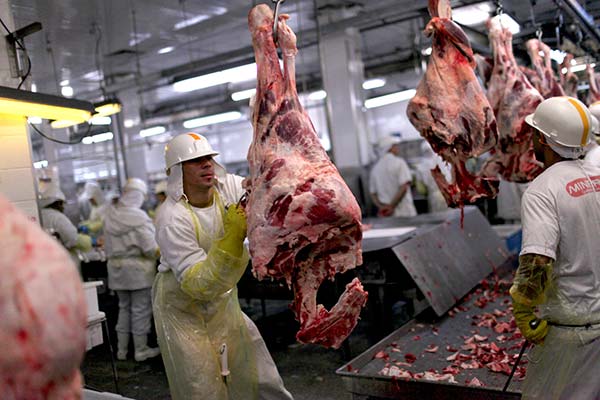
China beef exports expected to increase value
of U.S. grain
By TIM ALEXANDER
Illinois Correspondent
PEORIA, Ill. — U.S. beef producers learned earlier this month the
Chinese export market had reopened to them for the first time since 2003 – a
market worth an estimated $2.6 billion to the U.S. beef industry, according to
House Committee on Agriculture and others.
The lifting of the embargo on U.S. beef products is credited to
the U.S.-China 100-Day Action Plan, which brought together leaders from both
nations to negotiate details of a protocol for U.S. beef exports. The agreement
was announced June 12, with U.S. beef exports to China commencing shortly
afterward.
While the deal initially serves to benefit U.S. cattle producers,
the trickle-down effect will further benefit farmers who produce grain for
cattle feed. More corn and soybeans will likely be needed to help meet the feed
demand for additional beef products to China.
Grain commodity groups are analyzing the projected needs of the
Chinese market in order to meet demand, and adopting a wait-and-see attitude as
to exactly how much of an increase in production will be justified. Jim Bauman,
National Corn Growers Assoc. (NCGA) director of market analysis, said
increasing demand for U.S. corn in all forms is NCGA’s first priority.
“We congratulate and support the U.S. beef industry on their
efforts to reopen the Chinese market. Every additional pound of U.S. beef
exported equates to additional demand for U.S.-grown corn. On average, nearly
3.5 pounds of corn and 1.4 pounds of distillers dried grains (DDGS) are used to
produce one pound of U.S. beef,” said Bauman, in an email.
In 2015, red meat exports added 45 cents to the price of corn,
according to NCGA research. Based on an average yield of 200 bushels per acre
at $3.60 per bushel, an additional $90 per acre in revenue was generated.
“The NCGA supports our important partners in the beef industry
and we strongly support increased market access for beef exports,” he said.
“State corn organizations have invested corn checkoff dollars heavily towards
expanding overseas markets for decades.
“Meat exports are an important part of NCGA’s commitment to
maintaining and building profitable demand for corn. We look forward to working
closely with our partners in the beef industry to build demand for their
product both at home and abroad.”
The Illinois Soybean Assoc. (ISA) issued the following statement
regarding the expected increase in demand for soybeans and the value of the
beef export agreement:
“The ISA checkoff program values the market potential with the
resumption of U.S. beef exports to China. In the U.S., beef cattle consume more
than 1.4 million tons of soybean meal per year. Beef cattle also comprise an
important market for soybean hulls. Illinois soybean farmers look forward to
supplying feed to produce high-quality U.S. beef for the Chinese market.
“Because the market opening agreement includes requirements that
will involve an adjustment period for the U.S. industry, it is difficult to
predict the market potential for U.S. beef exports to China. Chinese beef
imports are projected at 950 metric tons. Before the ban, the U.S. held 70
percent market share for these imports, but it will take time to regain that
market.
“For soybean farmers, raising more beef cattle does create more
demand for soybean meal. A 100-head beef barn will use an estimated four tons
of soybean meal per year to feed cattle.”
Soy hulls, the hard coating found on soybeans, are used as a
valuable beef and dairy cattle feed after being separated during the crushing
process. Hulls are widely used as a protein and energy supplement for cattle,
providing nutrients in a fiber-based feed that is digested well by ruminants.
Seventy-three percent of every bushel of crushed soybeans is made
into meal, 18 percent into soybean oil and 6 percent is used as hulls,
according to Illinois Field and Bean
(March 2016) magazine. “Nearly 80 percent of each soybean becomes feed,” said
John Hagenbuch, a soybean grower from Utica and an ISA director. “Animal
agriculture is the top market for soybeans.”
A farmer and rancher who serves on the U.S. Agricultural Trade
Advisory Committee and operates a beef cattle feedlot anticipates value to be
added to U.S. corn and soybeans as a result of the China trade deal.
“With the fact that we will be able to move more product, we are
ultimately shipping corn and beans in another product to China,” said Steve
Fogelsong, who owns Black Gold Ranch and Feedlot in Astoria, Ill., and is a
past president of the National Cattlemen’s Beef Assoc. “This adds value to corn
and soybeans here in the U.S. That’s a big deal, and the best (example of)
rural development in my book, if you can take homegrown corn and beans, turn
them into beef and ship it somewhere else.”
|