New subsurface
manure placement tech for fieldwork
By
Celeste Baumgartner
Ohio
Correspondent
COLUMBUS,
Ohio — Ohio State University researchers are using a drag hose over growing
corn to inject liquid manure. At the University of Kentucky (UK) scientists are
figuring out how to make subsurface placement of poultry litter work. And Pennsylvania
State University researchers are assessing how to evaluate soil nitrate levels
after manure has been injected.
The
scientists are hoping to improve both water quality and the farmer’s bottom
line with their work.
“We’re
applying liquid swine and dairy manure to a growing corn crop using a drag hose,”
said Glen Arnold, OSU extension field specialist in Hancock County, Ohio. “The
drag hoses go out for a distance of three or four miles from a livestock farm.
The manure can be from the lagoon or pumped into a semi truck and delivered to
the to the edge of the field.”
Injecting
this manure into standing corn allows the farmers to replace most or all of the
sidedress nitrogen they traditionally buy for corn, Arnold explained. They “try
not to look too carefully” as they drag the hose through the growing corn. Three
years of small-plot data show they can drag the hose across corn that is up to
the leaf-four stage of growth without a yield loss.
Hog manure
will have between 35-45 pounds of available nitrogen in 1,000 gallons, Arnold
said. If a farmer puts 6,000 gallons of hog manure on the corn, then, depending
on what the manure test reads, they are probably putting between 175-200 units
of nitrogen on the field.
A farmer in
Darke County, working with Arnold, has been using this method for a while. “Over
the three years, the corn in the fields that we drag-hosed with manure are
running about 13 bushels to the acre better than the parts of the field that
were sidedressed with commercial fertilizer,” he reported.
This
drag-hose method can add maybe five weeks to the manure application season for
a commercial applicator. Traditionally, they are not in fields once the fields
have been planted. Once this method catches on, Arnold thinks companies will
spend more time developing better equipment; use will then improve across the
Midwest.
“From an
environmental point of view, you’re applying manure to a growing crop that is
going to capture those nutrients much better than when you put that manure out
in the fall – when much of the manure in Ohio is applied,” he explained. “Corn
is just getting to the point where it is going to want nitrogen, and here you
come with just about the perfect plant food.”
To the east
Meanwhile,
across the border in Pennsylvania, Robert Meinen, professor in the Penn State
agriculture department, is evaluating soil nitrate levels after liquid manure is
injected.
Manure placed
in bands often has a 30-inch spacing, Meinen said. There is an obvious zone
near the band that has higher nutrient content, and in between the bands there
are areas that don’t have as much nutrient content.
Most states
have a Pre-Sidedress Soil Nitrate test (PSNT) test with procedures specific to
their state, he said. The test looks at corn right before it goes into its
maximum nutrient uptake stage through July and August.
“We can look
at soil points where this corn is about a foot tall and measure the nitrate
level,” Meinen explained. “We take that nitrogen test value and, using the
calculations that are available for each state, predict if there is enough
nitrogen at this point to sustain that maximum growth and nutrient uptake to
get maximum crop yield for this season.”
If the value
is low, there is a calculation that will recommend how much more nitrogen
should be sidedressed into the rows of the growing crop to allow maximum
production, he said. This PSNT was designed when earlier researchers studied
soils with broadcast or surface application of manure, which distributed the
manure more evenly through the soil profile than when it is applied in bands.
“Some of the
work we’ve done is to look at the soil nitrate level at this point of the year
at each inch across those 30 inches,” Meinen said. “Then we develop a protocol
that allows soil testing to find out what the best average is of the nitrate,
based on the high nitrate level around the band and the low nitrate level in
between.”
The
scientists take five core samples that are 6 inches across and that allow them
to get the peak and the valley of that nitrate level. They repeat that four
times, Meinen explained.
“We find that
we have a good predictor that relates back to the PSNT test where we have the
traditional calibration of the broadcast of our application,” he said. “We’re
not concerned as much about the timing after the manure; it’s more important to
hit the timing before the corn puts on a lot of mass and takes up a lot of
nutrients.
“We used
primarily liquid dairy manure with our testing on our research farm, but we
would expect this recommended protocol to be acceptable with other manures.”
Down south
Joshua
McGrath, UK extension specialist in agricultural soil management, spent eight
years working on water quality related to agriculture in the Chesapeake Bay
area. In 2014 he brought that research and grants from the National Fish and
Wildlife Foundation and others with him to Kentucky.
He wondered
what the applicability would be; Kentucky does have local water quality
concerns, but the state is not near Lake Erie or the Chesapeake Bay. His
research involved the subsurface application of chicken litter, which looks a
bit like wood chips, he said. He learned if the technology can be developed for
nutrient conservation and yields, there is potential for farmers to save money.
Some of
McGrath’s work involved spraying the litter with a nitrification inhibitor at
each injection site, which slows the nitrification of ammonia,
ammonium-containing or urea-containing fertilizers, which are applied to soil.
“We did some
preliminary trials in Delaware and now in Kentucky, and saw significant
nitrogen benefit where we put down poultry litter and then sidedressed the
fertilizer nitrogen,” he said. “We found that this nitrification inhibitor will
preserve or protect the nitrogen in the poultry litter and will reduce the
total amount of fertilizer that the farmer has to buy as a supplement.”
The
scientists found significant nitrogen conservation benefits, McGrath said. They
could use much less nitrogen and get the same yield as with fertilizer. The
yields increased when the weather conditions were right for leaching or denitrification.
“So, when you
inject, you’re conserving that ammonia portion; you're not losing that off the
surface,” he explained. ”If you have a wet spring, we saw pretty big economic
benefits.”
The team has
looked at runoff and ammonia loss at work. They saw that minimizing ammonia
loss minimizes runoff of phosphorous and nitrogen. Some of the runoff trials
that injected poultry manure had the same amount of runoff as the check, which
had no phosphorous because it was all under the soil surface.
The problem
right now that the project funding is running out and as yet there is no piece
of equipment that works economically. Everyone involved in the research will
take part in a July meeting at the Chesapeake Bay to find ways to move the
project forward.
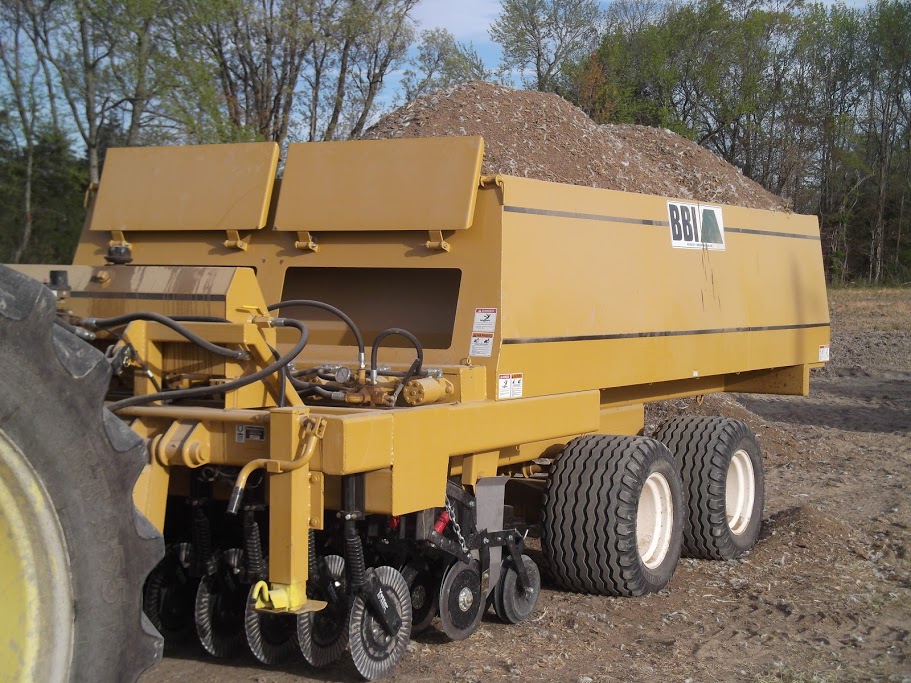
The equipment
the team is currently using is expensive and only 8 feet wide, McGrath said. It
can only inject over an 8-foot swath, compared to surface manure which can be
applied in 20- to 30-foot-wide swaths.
The
researchers and farmers are figuring out the mechanical problems with the
equipment, and are working with engineers to resolve them. They’ve made
headway, McGrath said. “We’ve got a prototype built that goes through two rows,
and that will allow them to test these challenges and come up with a solution,
and we can eventually come up with a scalable machine.”
McGrath said
he is not an engineer, and is accused of being too optimistic, but he hopes a
scalable machine could be running within about three years.
|