Sustainable
farming on tour of Chinese visitors to Indiana
By KRAIG YOUNTS
Farm World Intern – Indiana
BROWNSBURG, Ind. — The Indiana Soybean Alliance (ISA) welcomed
the Chinese Chamber of Commerce for Import and Export of Foodstuffs, Native
Produce and Animal By-Products (CFNA) and key industry stakeholders to Mike
Starkey’s family farm in Brownsburg on July 12.
Starkey said this is the third Chinese delegation to visit his
farm with a focus on conservation and sustainability. “We are a sixth-generation
farm,” he noted. “This has been around for a while.”
His 2,600-acre farm is not typical, as he does not stick to all-traditional
farming methods. He explained he could not stand by the methods that his father
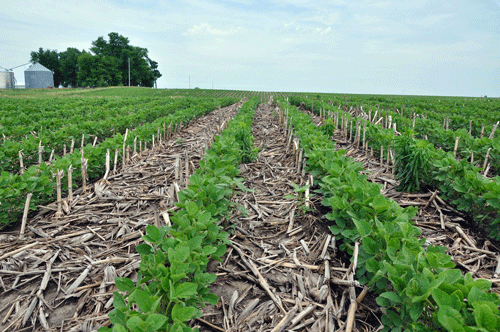
used; he simply can’t make a living doing so. Instead, by introducing no-till
and annual ryegrass as a cover crop, Starkey has considerably reduced his
expenses and use of herbicides. In addition, his profit margins have increased
substantially.
There are significant benefits that come with using no-till
farming, Starkey said. Leaving ground untilled allows more water and nutrients
to seep into the soil. This method can also halt soil erosion.
Soil becomes more fertile when it isn’t heavily disturbed, he
added. Earthworms allow Starkey to use considerably less fertilizer as they
break down the remnants of last year’s crop and turn it into valuable organic
matter that enriches soil.
Starkey changed his farming practices not only for personal gain,
but for the sake of the water the Eagle Creek watershed provides. The stream on
his farm is the third-largest tributary that supplies Indianapolis with
drinking water – he told his CFNA guests that they took their morning showers
with water from his property.
“I am part of an intense water monitoring program that tracks all
the water that comes off my farm,” Starkey explained. “They are finding that
the water that flows off my farm is lower in nitrates than water in the natural
stream.”
Not everyone is hip to leaving tradition behind. Starkey said
there are still those who farm in old ways. Many farmers still till their land,
spending time and money only to weaken and erode precious soil. Likewise, he
said many douse their farmland with pesticides and herbicides that can end up
washing into bodies of water intended for drinking.
Starkey believes, sooner or later, farmers will have to opt for
conservation measures and sustainable farming practices over tradition.
“Sustainable farming methods that are not destructive to the soil
are becoming more of a priority for China,” said Ed Ebert, senior director of
Grain Production and Utilization for the ISA. “The Chinese buy 25 percent of
all U.S. soybeans. Metaphorically, that means every fourth row grown is shipped
to China.”
Ebert explained how the ISA supports sustainable farming
operations such as Starkey’s. “We sponsor research in terms of conservation and
management techniques. We have funded programs this year and in the past, as
well.”
The CFNA’s visit held considerable significance. “This level of
group hardly ever comes to Indiana, but rather, to another major soybean
producer like Iowa or Illinois,” said Ebert. “But our partners at USSEC (U.S.
Soybean Export Council) made this trip available to the Chinese delegation.”
A day after the event at Starkey’s farm, Chinese soy buyers
signed a contract agreeing to buy 460 million bushels of this year’s U.S. soy
product. China will pay $5 billion for its purchase, which is a $1 billion
increase from last year. China imports about 60 percent of U.S. soybeans each
year.
When asked about his first impressions of Starkey’s farm,
Xiaoping Zhang, country director of the USSEC in China, said, “The farm is very
impressive and uses unique cultivation methods.
“It is good for the U.S. industry to promote sustainable farming;
this method of farming is in China’s near future.”
|