Tile drainage improves yields at
Beck’s PFR site in Illinois
By SUSAN BLOWER
Indiana Correspondent
ATLANTA, Ind. — Tile drainage is a popular addition to many
farms, but there is a lack of research on the best way to tile, including the
best depth or width of tiles. Beck’s Hybrids is attempting to change that with
their Practical Farm Research (PFR).
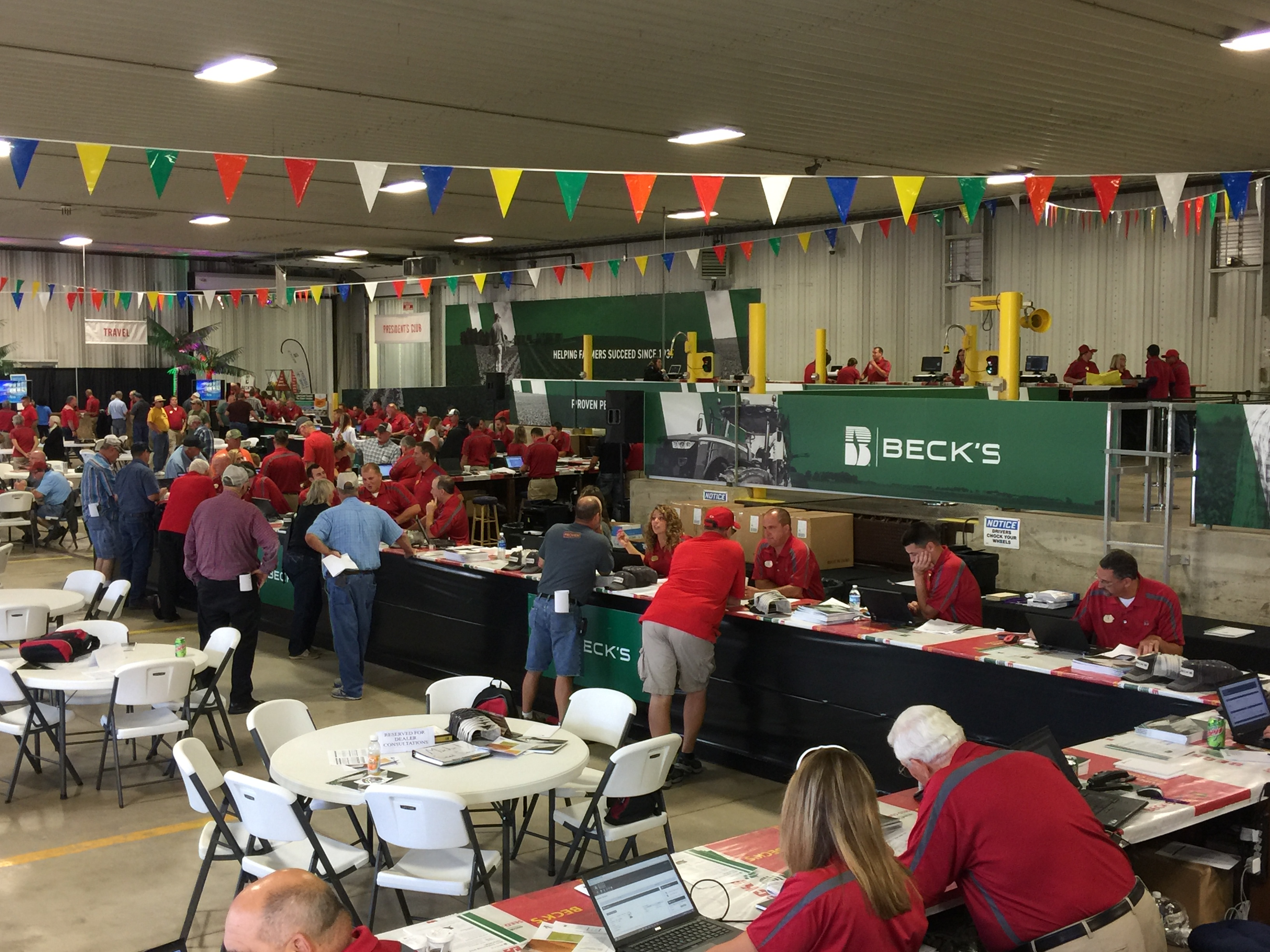
At last week’s Becknology Days in Atlanta, Ind., Jonathan
Perkins, PFR agronomist, was on hand to explain the latest water management
studies at Beck’s.
Preliminary results from water management sites in Effingham,
Ill. show a strong advantage to corn and soybean yields with any kind of
drainage tile, Perkins said. The field study, with only a year’s worth of data
so far, is being performed in poorly drained silt loam with a claypan layer
that is 12-16 inches below the surface, which is common on southern Illinois
farms.
“Conventional wisdom says that tile won’t work in this type of
field. But our job is to challenge the status quo,” Perkins said.
Yield data from 2016’s study shows a “strong advantage for any
crop with tiles,” Perkins said. Specifically, the studies show a 35-60 bushel
increase per acre for corn with tiles. Soybeans still saw an advantage with
tiling but not as much as corn, he added.
The tests also address tile width and depth by comparing lateral
runs of 15, 30 and 60 feet, as well as a control study of no tile, at depths of
24 and 36 inches.
In corn both tile depths consistently added similar yield
advantages until the width reached 60 ft. The biggest increase (of more than 55
bushels) came at 15 ft tile widths at both depths.
In soybeans, the shallow depth showed higher yield increases as
the tiles became narrower.
“Soybeans have a shallower rooting system than corn which could
be why we saw such yield gains in the 24 in. depths as the width went from 60
to 15 ft.,” according to the 2016 PFR Book.
Perkins said that the studies need about a 3-5 year duration to
confirm results. It’s too early to know yield data of 2017 yet – the second
year in the water management study – but the results will be published in
December’s PFR book.
“We are set up to go long term. Ten years would give us an
excellent read, but five years will give us a good idea,” he said.
Other tests conducted in Effingham in 2016 included controlled
water table, contour tile drainage and sub-irrigation. In southern Illinois the
claypan does not allow spring rains to drain well, while crops dry out toward
the end of the season.
In the controlled water table test, the gate was off during
periods of extensive rain to encourage drainage and capped in late-season dry
periods to raise the water table. In the contour water tile test, the field is
drained but does not raise the water table. Sub-irrigation was studied using
both sensors and manual control. 2016 results show in some cases the strongest
improvement in yield with sensor irrigation, Perkins said; however late June
rains improved the results for controlled water table.
Perkins expects this year’s dry weather since June will reveal a
bigger difference in irrigated crops.
In the control study, the corn yield reached 215.6 bushels per
acre. Sensor-based irrigation produced 227 bushels per acre, which was an 11.4
bushel advantage over the control. Contour tile and manual sub-irrigation
produced near-identical results with an 8.7 and 8.6 bushel advantage,
respectively. Controlled water table showed a 4.9 bushel increase per acre,
according to the 2016 PFR Book, also available online. (See pages 243-245 in
the 2016 PFR Book for more on water management in corn.)
Sub-irrigation shows a bigger difference in dry seasons. In 2012,
a drought year, past Beck’s studies showed a 60-bushel advantage.
For the soybeans test, yield improved by 10-16 bushels with the
sensor-based irrigation over the control test of no irrigation or tile
drainage, with results from manual sub-irrigation following closely. (See pages
258-260 in the 2016 PFR Book for soybean test results in water management.)
New this year to Beck’s field study in Effingham is the use of
drip fertigation, a method of fertilizing crop roots through an underground
drip line. Perkins said the method is used more widely in the western states.
“PFR tests the newer things out there and puts a pencil to it,”
Perkins said.
The fertigation drip line was placed 10-15 inches deep in the
soil in order to deliver nutrients closer to the roots than over-the-top pivot irrigation.
The study tests two treatments of drip fertigation -- with and
without tile drainage. The site uses a Netafim drip line installed by
NutriDrip, based in Kansas. The results will be published in December.
Currently the Effingham site includes corn and soybeans only, but
if farmers vocalize a desire for winter wheat tests, that crop may be added,
Perkins said. For further information, check beckshybrids.com
|