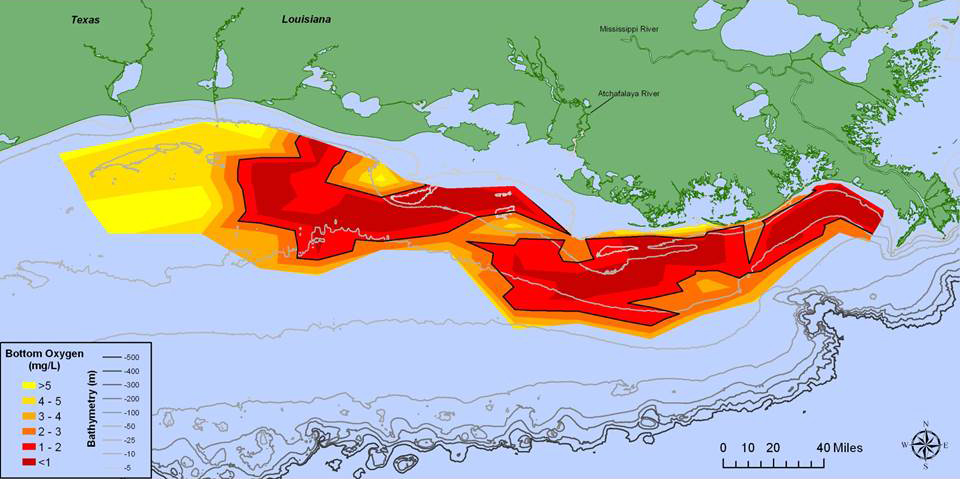
Gulf of Mexico ‘dead zone’ is
largest on record since 1985
By JORDAN STRICKLER
Kentucky Correspondent
NEW ORLEANS, La. — In the Gulf of Mexico lies an area which is
almost devoid of all marine life. An annual occurrence, this year’s “dead zone”
is the largest to be recorded since tracking began in 1985.
The 8,776 square-mile swath of sea is 3 percent larger than the
next-highest record of 8,497 square miles measured in 2002. Runoff from farms
and meat processing companies are named as two of the primary culprits.
"This large dead zone size shows that nutrient pollution,
primarily from agriculture and developed land runoff in the Mississippi River
watershed, is continuing to affect the nation's coastal resources and habitats
in the Gulf," the National Oceanic and Atmospheric Administration stated.
Dead zones occur around the world, but primarily near areas where
heavy agricultural and industrial activity spill nutrients into the water and
compromise its quality accordingly. Some dead zones do occur naturally, but the
prevalence of them since the 1970s hints at increased impact.
While nitrogen and phosphorous from agricultural runoff are the
primary sources, sewage, vehicular and industrial emissions and natural factors
also play a role in their development. Dead zones grow to their biggest size in
the summer when there is more fresh water sitting on the cold saltwater, which
blocks the oxygen from the atmosphere from mixing with the water underneath.
“Dead zones occur when the waters do not have enough oxygen to
support marine life,” explained Robert Bendick, Gulf of Mexico director of the
Nature Conservancy. “Algae blooms around the mouth of the river, and that algae
dies and sinks to the bottom.
“When it decomposes, it consumes oxygen in the water. A dead zone
is an area of very low oxygen. Marine life will either leave or die. This dead
zone is carried out to the west toward Texas from the mouth of the
(Mississippi) River.”
A national action plan by the Mississippi River-Gulf of Mexico
Watershed Nutrient Task Force – a coalition of federal, state and tribal
agencies – calls for reducing such runoff so the dead zone shrinks by two-thirds,
to 1,950 square miles, by 2035. That is approximately the size of Delaware.
That would require cutting the amount of nitrogen flowing into
the river by 59 percent, according to a study published in Proceedings of the National Academy of Sciences (PNAS).
“We expected one of the largest zones ever recorded because the
Mississippi River discharge levels, and the May data, indicated a high delivery
of nutrients during this critical month, which stimulates the mid-summer dead
zone,” said Nancy Rabalais, Ph.D., research professor at Louisiana State
University and Louisiana Universities Marine Consortium, who led the survey
mission.
River concentrations of the nitrogen compound nitrate have not shown
to decline since the 1980s. And the current five-year running average of the
nitrate load delivered to the Gulf is not significantly different from the
1980-96 baseline, despite the fact that U.S. farm bill conservation programs
spent more than $28 billion in the 20 Mississippi Basin states since 1995.
“The bottom line is that we will never reach the Action Plan’s
goal of 1,950 square miles until more serious actions are taken to reduce the
loss of Midwest fertilizers into the Mississippi River system,” said University
of Michigan aquatic ecologist Don Scavia, lead author of the PNAS paper.
“Clearly, something more or something different is needed,” he
and his colleagues wrote. “It matters little if the load-reduction target is 30
percent, 45 percent or 59 percent, if insufficient resources are in place to
make even modest reductions.”
Scavia said the dead zones can be reversed with several
relatively simple agricultural practices. Among those are changing fertilizer
application rates; using cover crops that prevent runoff or fast-growing crops
to prevent soil erosion; improving pollution management; and pursuing alternatives
to corn-based biofuel, which produce some of the nitrogen runoff.
A 20 percent nitrogen reduction would produce an 18 percent drop
in dead zone size over the long term, though it may not have a measurable
effect in the next five to 10 years.
|