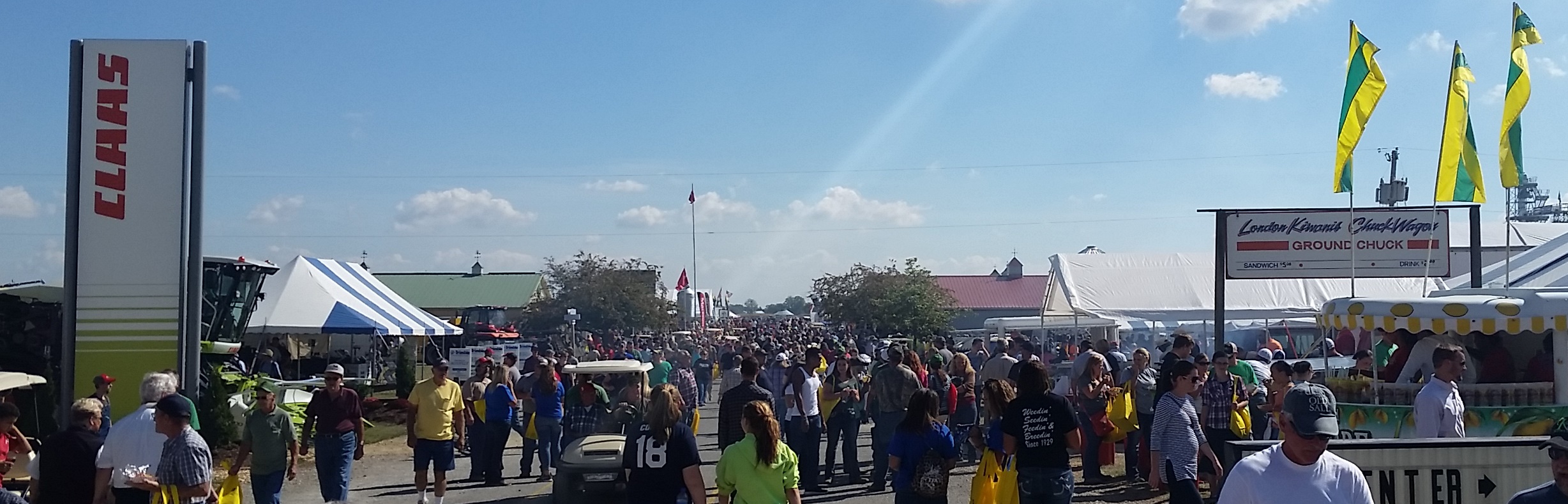
OSU climate researchers will help
farms adapt to changes: FSR seminar Sept. 21 @ 1 pm
By CELESTE BAUMGARTNER
Ohio Correspondent
LONDON, Ohio — Corn Belt farmers are likely aware of changes in long-term
weather, as are researchers at The Ohio State University. Those researchers
would like to reach out to farmers to help them adapt to weather changes and to
learn better ways for the two groups to communicate.
Aaron Wilson and Jason Cervenec will be talking about local
climate trends at the Farm Science Review (FSR) on Sept. 21, at 1 p.m. at the
Small Farm Center. They are both with OSU’s Byrd Polar and Climate Research
Center – Wilson is a senior research associate and Cervenec is outreach
director. Both men are also extension educators.
“If you look at the seasonal changes in temperature across much of
the Corn Belt region, the wintertime temperatures have been warming about twice
as fast as the summertime temperatures,” Wilson said. “Comparing the earliest 20th
century to conditions that we have now, we still have the variable year-to-year
changes, but overall the trend across the Corn Belt is a warming trend of 0.2
degree Fahrenheit per decade over the last hundred years.”
It is key that, relatively, nights are warming more quickly than
days. That trend is tied to the fact that there is more moisture in the
atmosphere, the researchers believe.
Also, while annual precipitation has increased, it is not evenly
distributed in all seasons, Wilson said. In Ohio, observed changes since the
mid 20th-century show increased summer and fall precipitation.
“We anticipate that our springtime precipitation can increase in
the future,” he explained. “If you think about having these events where we
have 2 to 4 inches of rain, where a lot of nutrients can be flushed out, you
also get soil movement and loss.”
Wilson and Cervenec will help local farmers understand the
changes that have already occurred and those that are anticipated over the next
50 years. The researchers can inform producers about adaptation steps they can
take now. They will help to connect people with the data and to understand what
that data mean over the long-term, Cervenec said.
Their goal is to figure out what people want to see by crop or
livestock variety so they can customize that information, he added. There are a
massive amount of data available, but individual producers want certain
indicators – like, when is the last frost going to hit? What is average temperature
going to be at night?
“If you are going to be in this for 20 or 30 more years and you
are going to build any infrastructure or lay field tile, is that field tile
going to be of sufficient capacity to drain those heavy rainfall events?”
Cervenec mused. “Don’t build something that is not going to be able to handle
loads that you are going to have to put on it in the future.
“Think about what your risks are and what changes your part of
the state is going to see, and base your decisions accordingly.”
At the FSR, Wilson and Cervenec will demonstrate the new FARM
precipitation database and additional visualizations, as well as provide
information on current weather and recent climate. They also encourage
producers to call the State Climate Office of Ohio with questions and to visit https://climate.osu.edu
|