Great Lakes’ rail bypass idea dead for lack
of enough funds
By STAN MADDUX
Indiana Correspondent
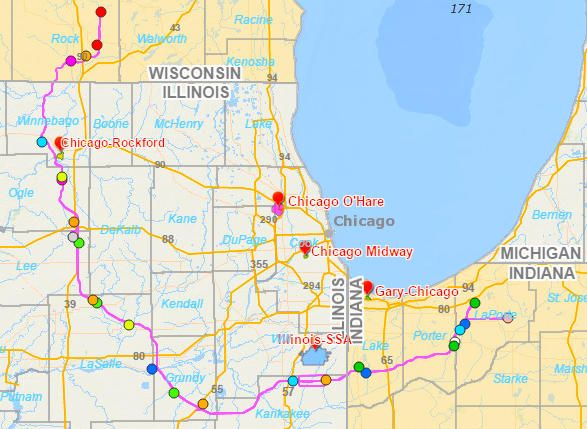
WASHINGTON D.C. — It would cost billions to construct a rail line
from Wisconsin to Indiana, but a company wanting to do just that might not have
enough funds to lay a single track.
Citing financial concerns, the federal Surface Transportation
Board (STB) has rejected the application of Great Lakes Basin Transportation,
Inc. (GLBT) to build the 261-mile line. In its August 31 decision, the STB
ruled it was unable to determine if GLBT could afford to construct the line
because of financial information on the application cited as “flawed.”
Specifically, the board pointed out listed as net income was $1.2
million in red ink, and since no explanation was given for the calculation or
discrepancy, a decision on the financial condition of GLBT could not be
reliably made. GLBT, funded strictly by contributions from investors, also
listed a net worth on its application only in the lower three-figures.
“While the board does not require that construction projects be
fully funded at the outset of a construction application proceeding, the
financial fitness of the applicant is part of the application process. GLBT’s
current assets of $151 are so clearly deficient for purposes of constructing a
261-mile rail line that the board will not proceed with this application,” the
STB stated.
It explained determining an applicant’s financial condition is
part of the process to protect shippers from decisions that could jeopardize
the carrier’s ability to carry out its obligation to them and communities from
construction projects not being completed.
Frank Patton, chair of the GLBT, was listed as the major
shareholder with 87 percent ownership, according to filings with the STB.
Illinois Farm Bureau (IFB) and county chapters upset about
possible destruction of farmland and disruption of operations at farms
separated by rail lines applauded the application being denied.
“Despite evidence showing the rail line unnecessary, the proposed
261-mile project would have cut through prime Illinois farmland, disturbing
nearly 5,000 acres for the rail line and another 14,700 acres for the railport
in Manteno,” said Richard Guebert Jr., president of IFB.
“We’re happy to see that the Surface Transportation board
concurred with our written objections when they found GLBT’s application to be
incomplete and the company’s assets insufficient to complete such a project,” he
said.
The line would have run from southeastern Wisconsin to northwestern
Indiana veering around existing heavy rail congestion in Chicago.
GLBT, citing a need for more complete information on its original
application, withdrew it then, several months later, refiled the application
with new plans to also construct a privately funded toll road to connect the
Indiana Toll Road with interstates 80/94 and 65 near Gary and interstates 57,
55 and 80 in northeastern Illinois.
Indiana state Sen. Mike Bohacek, whose district includes an area
the line would pass through, believes the idea for a toll road was to generate
revenue for constructing the railroad, and questions if the project ever had
sufficient financing.
There was speculation about hundreds, if not, thousands of jobs
being created especially if a transloading facility went up at the end of the
line in Kingsbury 20 miles south of Indiana’s Lake Michigan shoreline.
Bohacek seriously questioned the potential job impact, pointing
out no major railroad ever signed up to use the line. He also said no
additional rail traffic would be produced by the line, which would merely
relieve congestion from existing railcars.
“There’s just not a need for it. None of the Class 1 railroads
have an appetite for it. Neither does the investment community, so the
application was denied and that was the right thing to happen,” said Bohacek, a
Republican from LaPorte County.
|