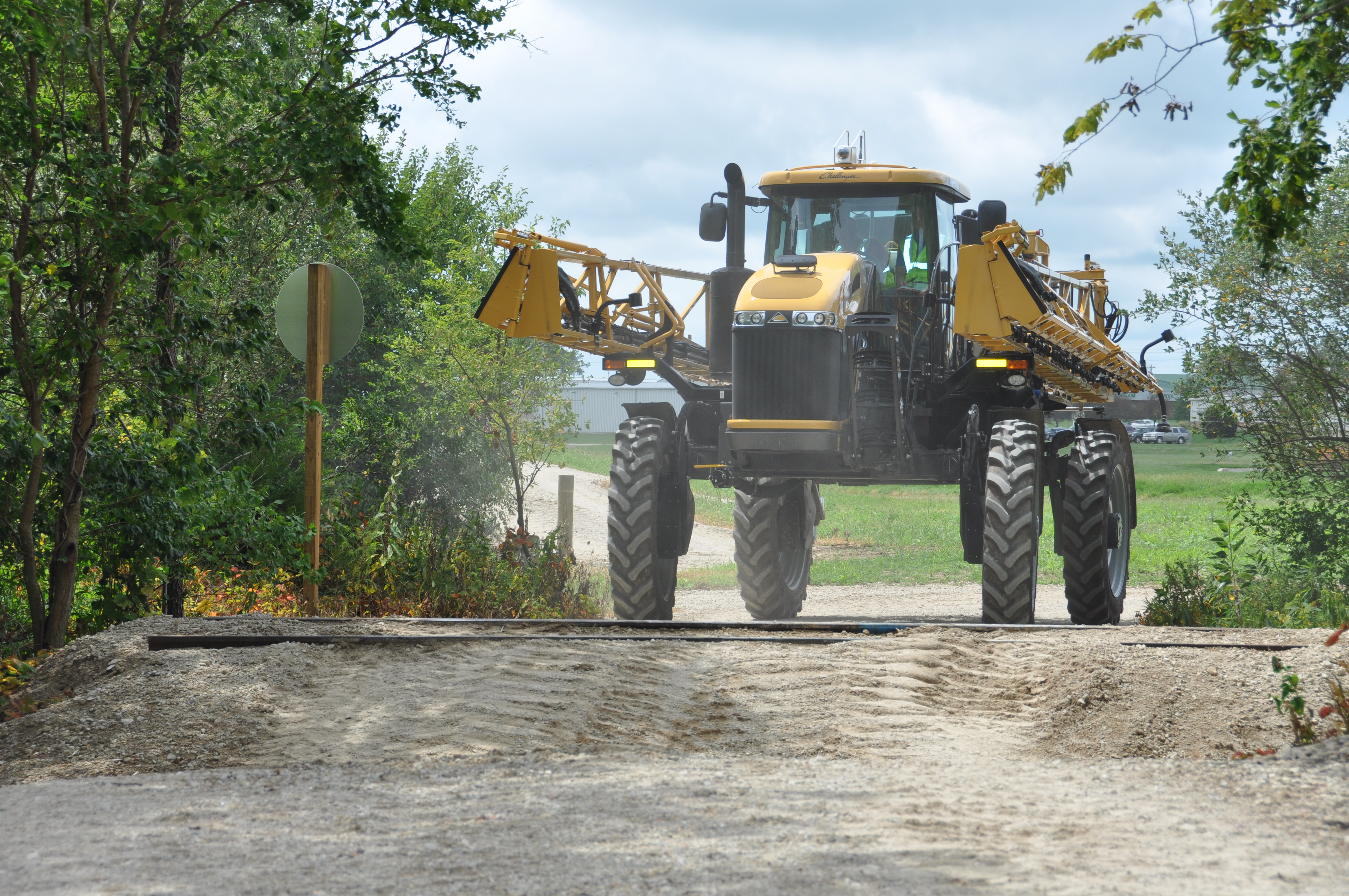
Applicator course classes, 1-mile
training track tout safety
By TIM
ALEXANDER
Illinois
Correspondent
BLOOMINGTON,
Ill. — The first three classes of students enrolled in the Applicator Training
Course at the new Asmark-AGCO Applicator Training Center have recently
graduated, earning certification as properly trained, professional applicators.
Each class of
20 students received basic operating skills and machine-specific, hands-on
training from course leaders and industry technical representatives requiring knowledge
of math, chemistry, measurement, technology and customer skills.
The
Applicator Training Center, at 10226 E. 1400 North Road in Bloomington, Ill.,
is the nation’s most complete training facility for those seeking the skills
and knowledge to operate complex, technologically advanced crop protection and
pesticide application equipment.
The four-day
training course, developed by The Asmark Institute, was created to address the
challenge of finding and properly training new (and not-so-new) applicators to
make proper crop nutrient and crop protection product decisions and
applications.
“The students
have the ability to evaluate the situation for each load and field and be
prepared to optimize the application or make the decision to delay or not spray
if that is the right thing to do,” said Allen Summers, president of the Asmark
Institute, an Owensboro, Ky.-based, not-for-profit educational organization
created in 2005 to deliver Asmark’s collection of educational training
materials to the retail farm sector.
“We’ve
received positive response from all levels of the retail and crop protection
industry, so we’re excited to get underway.”
Classroom, hands-on training
The training
instruction team brings more than 80 years of experience in their fields to the
training center’s classrooms, which were specially built as part of the new,
6,000 square-foot Applicator Training Center, along with offices, board rooms
and a lobby that serves as a mini-museum to the history of crop field
application. Lead instructor Greg Yoder of Danvers, Illinois has been a
respected crop application management professional for more than four decades,
as has Dr. Robert Wolf, particularly for his work with spray drift and
application technologies.
“We position
the course as a boot camp,” said Summers. “It’s for beginners, zero-to-three
years experience. Applicators are the ones that interface with the customer
more than any other person at a retail facility. We talk to them about
professionalism, and then we go into how to start a field.”
The classes,
which cost $575 per student (usually covered by employers), begin on Tuesday
mornings at 8 a.m. and end on Fridays at 2 p.m. Like most school curriculum,
courses include classroom training and bookwork. Training includes how to read
and understand product labels and safety data sheets, measurement calculations
such as ounces, pints and gallons, proper tank cleanout procedures and record
keeping.
Also covered
is the biology of weed resistance development, the importance of moving toward
a program approach for weed control, and rotating herbicide modes of action in
lieu of single-mode action. Students learn how to reduce or eliminate
off-target applications due to spray drift by learning the relationship between
pressure, nozzle, droplet size and speed. Projectors inside the classroom
convey images, charts and other data onto a floor area centered around
classroom tables and the instructor’s podium.
Hands-on
training includes building a functional spraying system by properly attaching
hoses to each component of a pre-plumbed system. Students must demonstrate
competency in all aspects of the course, especially during a tabletop scenario
used to decide to “spray or not to spray” based on various scenarios.
Drive-and-ride tests proficiency
The reward
comes when students are introduced to the big machines they’ll be required to
operate on the training center’s mile-long, all-weather training track, which
includes hazards such as utility poles and power lines (laser simulated),
railroad crossings, overgrown entrances and changing field conditions.
The
drive-and-ride exercise, as one might imagine, is the favorite aspect of the
course to many of the first graduates.
“The
classroom work and the demonstrations were all great but the driving was an
eye-opener,” said Levi Harp of Easton, Ill. “I truly learned a lot and enjoyed
it.”
Added Dustin
Twellman of St. Charles, Mo., “The ride-and-drive was very real and had the
things I see every day in the field.”
Summers
explained that on Thursday, the day of the ride-and drives, students break up
into two groups. “Half go on the ride-and-drive and the other half go to three
self-study exercises. The self-study exercises are on how to secure a machine
on a trailer, how to connect components of a sprayer and the procedures of
transferring (materials) from a nurse truck into an applicator,” he said. “Each
half of the class does that for three hours, then they switch.”
Asmark
developed the training course’s unique power line simulator along with CornBelt
Energy, which contributed three electrical poles equipped with invisible laser
sensors that sound when triggered by an applicator’s boom arm. “A horn goes off
and a light goes off and at that point (drivers) would know they were in
trouble,” Summers said. “Every year we lose an applicator in our client base to
a fatality involving an electrical line. We also lose one each year to being
struck by a train crossing into a field, and we probably have close to 100
accidents occur each year when an applicator is trying to turn left as a motor
vehicle tries to pass them on the left.”
There are
some 20 sections to get through during the four days of the course, and
students must demonstrate proficiency and knowledge of all facets of the
training through written, oral and hands-on tests. “They participate in an
audience response session and answer questions after each section, making sure
they all stay together in the process and don’t leave anybody behind,” said
Summers. “They have a 48-question final applicator’s test at the end, and based
on their demonstration of proficiency throughout the course they get a
certificate of completion.”
‘First crop’ of students
The first
“crop” of students to take part in the Applicator Training Course hailed from
Illinois, Oklahoma, Nebraska, Michigan, Ohio, Tennessee and Indiana. The course
is the fourth signature training course launched by the Asmark Institute (along
with anhydrous ammonia technician training, safe grain handling operations, and
emergency response to agriculture incidents), and is the only one of its kind
in the country, according to Summers.
“The class is
top-notch and made me feel comfortable in learning how to become a professional
applicator,” says training center graduate Garth Osborne of Ivesdale, Ill. “The
experience and knowledge of the instructors made for a great interactive
experience – I can’t imagine a better way to learn how to be an applicator.”
Austin
Burgess, of Effingham, Ill., added, “I am more of a hands-on person, so being
able to move around between all the demonstrations was great.”
During a
twelve-month period, 400 seats will be made available for students wishing to
enroll in the Asmark Applicator Training Course. Those interested in more
information on the Asmark-AGCO Applicator Training Center and Applicator
Training Course should visit www.asmark.org/TrainingCourses
|