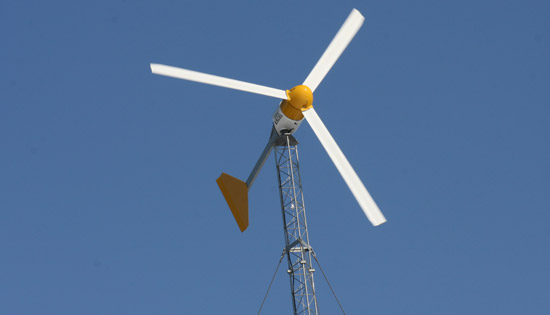
Small wind
turbines gaining popularity for Ohio farmers
By DOUG GRAVES
Ohio Correspondent
COLUMBUS, Ohio — So much has been made about wind farms of late.
Ohio farmers, along with businesses and industries, have been installing medium
to large wind turbines for more than a decade and the state is now ranked sixth
in the nation for the amount of power these turbines can generate for on-site
use or nearby delivery.
In an annual market report issues last week, the U.S. Department
of Energy (DOE) said by the end of 2016, non-utility wind turbines in Ohio had
a total generating capacity of 42.5 megawatts, or 42.5 million watts.
Big may be better, but not all farmers can afford these monstrous
energy producers on their farm. They are not cheap. Some farmers are turning
their attention to smaller turbines, then, designed strictly for the farm.
Across the United States last year, roughly 77,000 smaller
turbines were installed in all 50 states. These are producing power range in
capacity from a few hundred watts to 500 kilowatts and even as large as 1-2 MWs
– from backyard-sized machines up to utility-scale turbines for on-site
industrial use.
Much smaller than the business-scale turbines, yet a bit larger
than those smaller turbines, one will find six 120-foot-tall turbines at the
farm of Ralph Dull near Brookville, in western Ohio. The Dull homestead is a
model of modern agriculture and much has been done in the name of efficiency,
stewardship of the land and technology.
In the spring of 2004, the Dull family, with their contractor
Third Sun Solar and Wind Power, raised six Bergey Excel-S 10-kW wind
generators. They are placed in a row running north-south to harvest the
predominant wind from the west.
“The output from our turbines is processed by battery-free inverters,
then fed into the farm’s three-phase 208-volt power system,” Dull explained,
“offsetting the most expensive power used on the farm. The six generators were
selected to keep the three-phase power balanced and provide maximum power from
available space.”
Renewable energy is not the first of the farm owners’ moves
toward sustainable practices. They have successfully designed and constructed
an on-site biomass-fired seed drying process, eliminating thousands of BTUs of
gas previously used for this energy-intensive step.
Though Dull didn’t disclose the cost of erecting the six
turbines, according to the DOE such turbines can cost farmers upwards of
$20,000 to install.
Turbine installation is becoming easier and the costs have
plummeted over time. More importantly, farmers can erect such turbines that are
half as high as the Dull farm’s, with the ability to take care of smaller
electrical needs on the farm, such as lighting and bin drying.
Dave Mays of Hillsboro uses three small 80-foot turbines to
offset some electrical costs from his hog farm. Mays said he waited several
years for manufacturers to work out the “kinks” in the turbines and waited for
the cost of erecting them to drop as well. Their $8,000 price tag wasn’t cheap,
he pointed out.
“I’ve learned that wind turbines need wind. Not just any wind,
but the nicely flowing, smooth, laminar kind,” he said. “That cannot be found
at 30 feet, nor can it be found at 60 feet. You need to reach 80 feet where the
wind is often steady.
“Close to the ground, the wind is turbulent, and makes a poor
fuel for the smaller turbines that are hitting the market,” he explained.
|