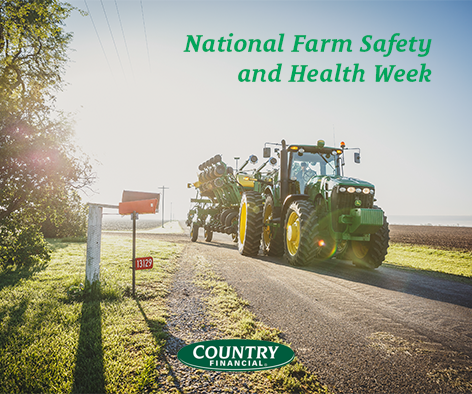
Remember, ‘safety first’ during busy harvest
time
By CINDY LADAGE
Illinois Correspondent
BLOOMINGTON, Ill. — A farm safety fact sheet from the
Occupational Safety and Health Administration (OSHA) begins by stating:
“Contrary to the popular image of fresh air and peaceful surroundings, a farm
is not a hazard-free work setting. Every year, thousands of farm workers are
injured and hundreds more die in farming accidents.
“According to the National Safety Council, agriculture is the
most hazardous industry in the nation.” This is especially true during the
harvest season.
Alexandrea Williams, public safety specialist for COUNTRY Financial,
wants to remind farmers to remember safety first. “Harvest is here – that means
farmers are already moving equipment on roads, harvesting their crop and
hauling it to elevators.
“Over the next few weeks and months they’ll be working longer
hours, starting their days before sunrise without resting until long after
sunset. The pressure to keep going can be intense and this can lead to
accidents, injuries and even death.”
Taking time to keep a few things first and foremost can help keep
farmers and those working and traveling around them safe. Following
manufacturers’ recommendations on machinery, OSHA says, can help reduce
accidents with equipment and machinery.
According to the federal Department of Labor agency: “Most farm
accidents and fatalities involve machinery. Proper machine guarding and doing
equipment maintenance according to manufacturers’ recommendations can help
prevent accidents.”
OSHA advised farmers decrease risk by increasing their awareness
of farming hazards and making a conscious effort to prepare for emergency
situations including fires, vehicle accidents, electrical shocks from equipment
and wires and chemical exposures.
“Be especially alert to hazards that may affect children and the
elderly. Minimize hazards by carefully selecting the products you buy to ensure
that you provide good tools and equipment. Always use seat belts when operating
tractors, and establish and maintain good housekeeping practices,” it added.
Some of the other safety advice includes:
•Read and follow instructions in equipment operator manuals and
on product labels
•Inspect equipment routinely for problems that may cause
accidents
•Discuss safety hazards and emergency procedures with workers
•Install approved rollover protective structures, protective
enclosures or protective frames on tractors
•Make sure that guards on farm equipment are replaced after
maintenance
•Review and follow instructions in material safety data sheets
(MSDS) and on labels that come with chemical products – and communicate
information on these hazards to family and other farm workers
•Be sure farm workers who speak little or no English also have
access to safety information and training in their primary language
Often family farms use the assistance of older and young workers,
and the Centers for Disease Control and Prevention (CDC) reports that the
biggest sources of youth ag-related deaths include – from the highest
percentage to the lowest – machinery, motor vehicles and drowning. While
drowning doesn’t play into harvest (except a form of drowning in grain bins
from grain instability), the other two do.
Many farmers are harvesting with farm equipment that includes a
semi or two-ton grain truck. Sometimes underage drivers are helping out on a
family farm, and this can lead to injury, especially when farmers are rushing
to get the crop done.
“Farmers are always anxious to get their crops out. They work on
tight deadlines, are often up against poor weather and numerous other setbacks.
It can be frustrating – but they need to remember to take care of themselves,”
said Eric Vanasdale, senior loss control representative at COUNTRY Financial.
“Accidents happen when we’re tired, distracted, stressed and rushed.”
Country has a few tips to add to OSHA’s list that, while they are
basic common sense, are easy to forget in the rush of harvest:
•Avoid driving machinery on roads at dawn and dusk
•Tell family and helping hands where you’ll be working and when
•Communication is a key element if an accident happens; keep a
cell phone or two-way radio near at all times, and keep your electronics
charged and on the ready
•Plan to communicate at set times of the day to ensure everyone
is safe and okay
Even the most seasoned of farmers often disregard the advice to
get plenty of rest and take frequent breaks. “Drink plenty of fluids frequently
and have healthy snacks on hand to keep your energy levels up. Accidents are
more likely to happen once fatigue sets in,” Williams cautioned.
For those on medication, she said to be sure to know if it is safe
to mix your prescription medication with heavy equipment. “Some medications and
machinery don’t mix. Consult your doctor if your medications make you feel
drowsy or impair your ability to safely operate your equipment,” she explained.
In central Illinois, the dry weather has made combine and field
fires a daily occurrence. To help prevent this, “Keep combines and tractors
clean and lubricated. Avoid fires by cleaning off your equipment each day and
following the manufacturer’s lubrication schedule.”
These are just a few of
the things farmers can do to put safety first. To learn more, talk with your
local extension office or go online to www.osha.gov/dsg/topics/agriculturaloperations/index.html
|