Multiple livestock groups seek
$150M for FMD Vaccine Bank
By TIM ALEXANDER
Illinois Correspondent
SPRINGFIELD, Ill. — The Illinois Pork Producers Assoc. (IPPA)
voiced its support for federal funding to establish a Foot and Mouth Disease
(FMD) Vaccine Bank in the 2018 farm bill, an initiative supported by the
National Pork Producers Council (NPPC), National Cattlemen’s Beef Assoc. (NCBA)
and the American Beef Assoc., among others.
The first-of-its-kind bank would give the livestock industry
rapid access to crucial vaccines for animals if an epidemic of FMD were to hit
U.S. farms or processing facilities, proponents say.
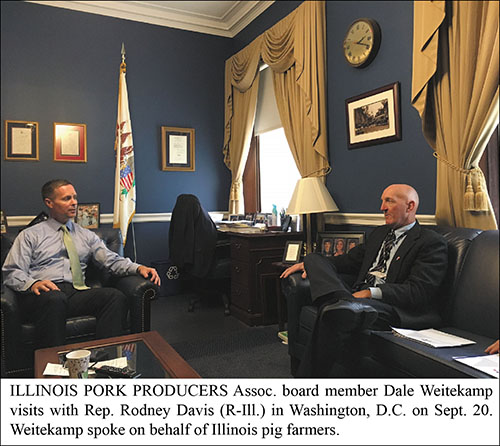
During a two-day September visit to Washington, D.C., to take
part in the annual NPPC legislative action conference, IPPA leaders including President
Jason Propst met with all 20 members of the Illinois Congressional delegation
to lobby for $150 million through the farm bill to establish the FMD vaccine
bank.
“We put a lot of focus on the vaccine bank when (USDA) Secretary
(Sonny) Perdue was in Illinois in early August, and also brought it to the
forefront during the (August 29-31) Farm Progress Show,” said Propst. “The
efforts are intensifying as we get closer to a farm bill.”
NPPC and affiliated state associations have made the creation of
the bank one of their top legislative priorities in the shaping of the new farm
bill. An FMD outbreak in the United States presents a critical risk to the
entire livestock industry, and could cripple the agricultural sector with long-lasting
economic ramifications.
If all U.S. export markets were closed to livestock, the cost to
the beef, pork, corn and soybean sectors alone could reach almost $200 billion
after 10 years, Iowa State University researchers estimate.
“If this country ever had an FMD outbreak, it not only would
devastate my farm and the whole livestock industry, but the entire U.S.
economy,” said NPPC Vice President David Herring, who recently lobbied for
funding for the vaccine bank before the House Agriculture Subcommittee on
Livestock and Foreign Agriculture.
Proponents are asking Congress to write the 2018 farm bill to
direct the USDA to do the following in establishing the FMD vaccine bank,
according to an NPPC news release:
•Contract with an offshore,
vendor-maintained vaccine bank that would have available FMD antigen
concentrate to protect against all 23 of the most common FMD types currently
circulating in the world
•Maintain a
vendor-managed inventory of 10 million doses of vaccine, which is the estimated
need for the first two weeks of an outbreak
•Contract with (an)
international manufacturer(s) for the surge capacity to produce at least 40
million doses
The $150 million proposal gained some traction with Illinois
legislators during IPPA’s Capitol Hill visit, according to Propst, with many
lawmakers expressing near-immediate support for the vaccine bank and others
requesting more data.
“They understood the importance of the livestock industry to the
Illinois economy, so most everybody saw this as a good insurance program to
protect the livestock industry and, in turn, our corn and soybean farmers,” he
said.
In Illinois, more than 2,000 farms produce 5.1 million hogs,
contributing more than $1.8 billion to the state’s annual economy. This
generates more than $170 million in taxes and provides more than 21,900 jobs,
according to IPPA.
The proposal seems to be enjoying bipartisan support at the
federal level as well, according to NPPC Senior Director of Public Relations
Jim Monroe. “There is very strong, widespread bipartisan support for this,” he
said. “We had pork producers from all over the country in town during our
legislative conference, talking to their representatives about the FMD vaccine
bank, which has been among our top priorities for the new farm bill. We are
participating in (lawmakers’) listening sessions.
“There just seems to be strong support for this in Congress.
Secretary Perdue is in support. The challenge, as always, is in the funding for
the farm bill. It’s up to Congress to work that out, but we are getting
feedback that suggests very strong support.”
Craig Uden, a fourth-generation cattle producer from Nebraska and
NCBA president, also asked the House subcommittee to authorize $150 million
over five years for a stronger and more adequate FMD vaccine bank.
“FMD is highly contagious and has the potential to spread widely
and rapidly, debilitating our herds,” he explained. “An FMD outbreak has the
potential to cause enormous economic losses not only to livestock producers,
but also to auction markets, slaughterhouses, food processors and related
industries.”
The establishment of an FMD bank should be strongly considered
not only because of its risk of accidental transmission, but also due to FMD’s
potential as a weapon of bioterrorism, Monroe noted.
“There is an ever-growing risk of an FMD outbreak driven by
continued globalization, and in this day and age, we have to consider potential
bioterrorism as a relatively new and growing risk,” he said. “While there has
been some time since an actual outbreak of FMD in the U.S., there are strains
circulating in regions across the globe.
“Given the threats I just mentioned, we strongly believe it is
important we get prepared for an outbreak and the impact from such an outbreak.
The economic impact alone would be devastating on our U.S. economy; therefore,
we think federal funding is warranted.”
USDA’s Animal and Plant Health Inspection Service manages a
vaccine bank on Plum Island where vaccine antigen concentrate for a limited
number of FMD strains is stored, according to the NPPC. However, the antigen
would need to be shipped to England or France to be turned into finished
vaccine before being distributed to U.S. veterinarians and farmers.
The turnaround time for such a scenario is weeks for a small
outbreak, and months for a large one, the NPPC warns.
The United States was hit with outbreaks of FMD only twice in the
past century – in 1924 (two outbreaks) and 1929 (California only), according to
the FAO World Reference Library for FMD. Since the development of a federal
system of inspection and quarantine for imported livestock, no outbreaks have
occurred.
|