La Porte
High School’s ag class growing new leaders
By STAN MADDUX
Indiana Correspondent
LA PORTE, Ind. — Students at La Porte High School are being
taught just how skilled farmers have to be to feed the world.
Not only are they learning how to raise and harvest crops and fix
some of the dreaded mechanical breakdowns that come with being a farmer, but
also the science and mathematics involved in food reaching their dinner tables.
But for Aubrey Gierke, one of the major benefits of being in the
agriculture class now in its third year has been leadership skills and
confidence she has acquired since enrolling as a freshman. She was recently
elected president of the FFA chapter at her school – though it wasn’t that long
ago she was content remaining in her shell.
“I was extremely shy,” said Gierke, now a junior. Her interest in
the course stemmed from raising sheep during her 10 years as a member of 4-H
and having several relatives involved in agriculture for a living.
All students, after enrolling in the course, are given the option
of becoming members of the local FFA chapter, and Gierke joined. Early on, her
FFA assignments included speaking to local service organizations such as
Kiwanis and Rotary, and as she began growing the door opened for becoming an
entry-level officer with her FFA chapter.
“From there on out I just matured as an adult,” said Gierke, who
just moved from nearby Stillwell to La Porte.
Currently, there are more than 100 students enrolled in the high
school’s agriculture course and roughly half are members of the local FFA
chapter, said Rob Walker, course instructor. Sweet corn, pumpkins and other
crops including soybeans have been planted and harvested each year with help
from students in the class, on a five-acre parcel beside the school corporation
administrative offices at 1921 A Street, he explained.
Students also learn how to do electrical work and other skills
like welding – skills farmers use themselves whenever possible to hold the line
on expenses. Eventually, according to Principal Ben Tonagel, students will be
taught how to fix tractors and other heavy farm machinery.
He’s also hoping to soon add a second teacher for the program.
“That’s how popular the courses are,” he noted.
Not every student wants to make their living on a farm, but may enroll
for the experience of hands-on learning, then leave with skills they can use in
other occupations and do-it-yourself projects at home.
“We have a lot of students who just want to learn by doing, and
that’s our motto: ‘Learning to do and doing to learn,’” said Walker.
Landscaping is also taught. Presently, students are applying
those skills to help shape the grounds at the new Rumely-Allis Chalmers
Heritage Center, a museum at the LaPorte County fairgrounds dedicated to the
long history of the farm equipment manufacturing giants.
“They asked us to come over. It’s a neat partnership for us,”
said Walker, noting some of the museum’s old tractors will be restored by his
students once the mechanical portion of the course starts.
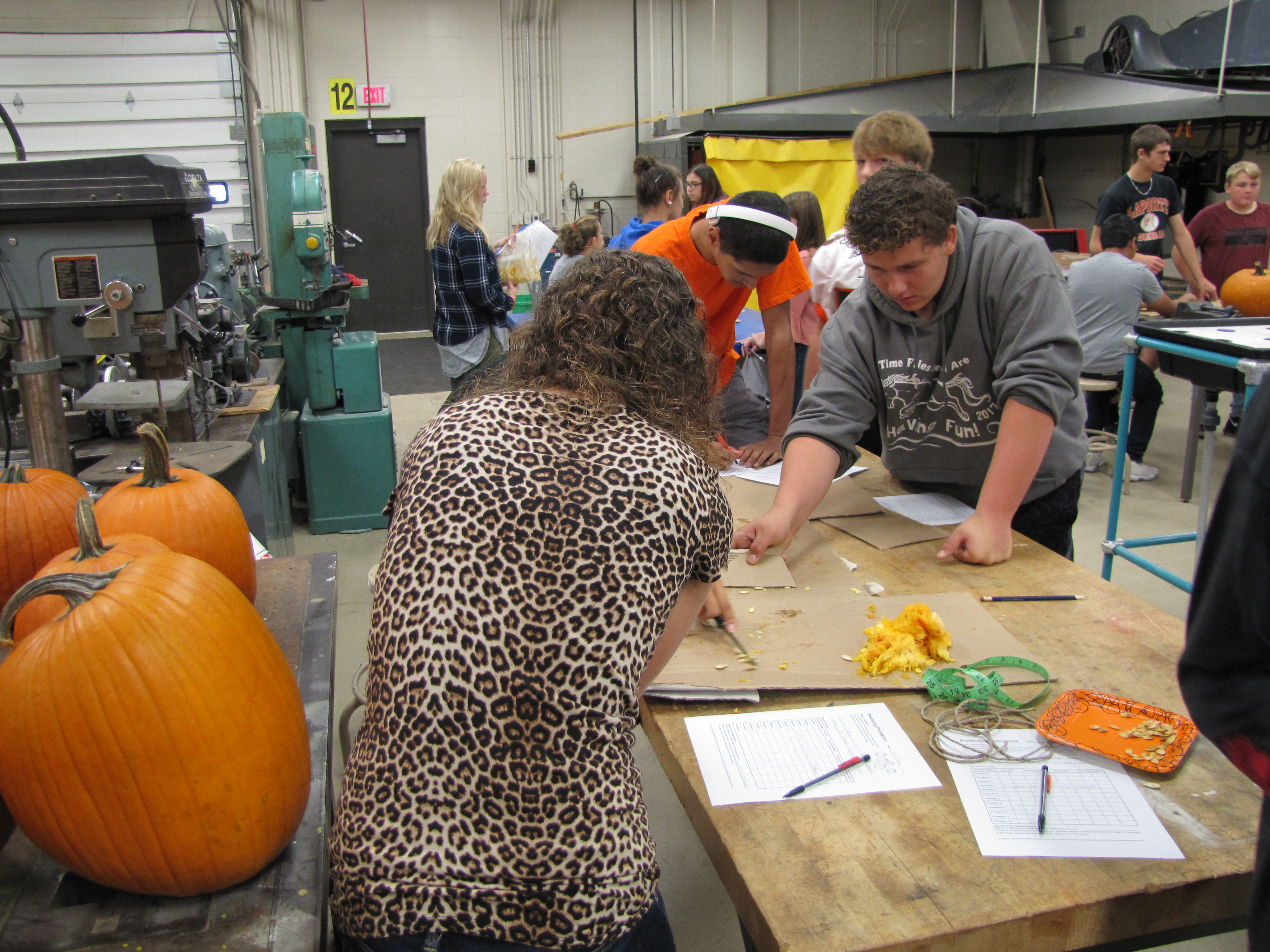
Lately, one of the assignments involved students at different
work stations calculating how many seeds were inside each of the pumpkins they
were assigned, based on their weight and size. They also cut open the pumpkins
brought in from the Pinney Purdue Agricultural Research Center at Wanatah, to
see how close they were on their calculations, and were given some of the seeds
to sample.
Becca Tuholski, whose family raises corn and soybeans on 6,000
acres, helps with the instruction as an educator with the Purdue University extension
office in La Porte. She said awareness of where food comes from, along with the
work and economics involved in getting it to the consumer, are other important
aspects taught in the course.
“Bringing agriculture and food into the school and into the
curriculum is really neat, and I think it’s important,” said Tuholski, a 2009
La Porte High School graduate herself.
|