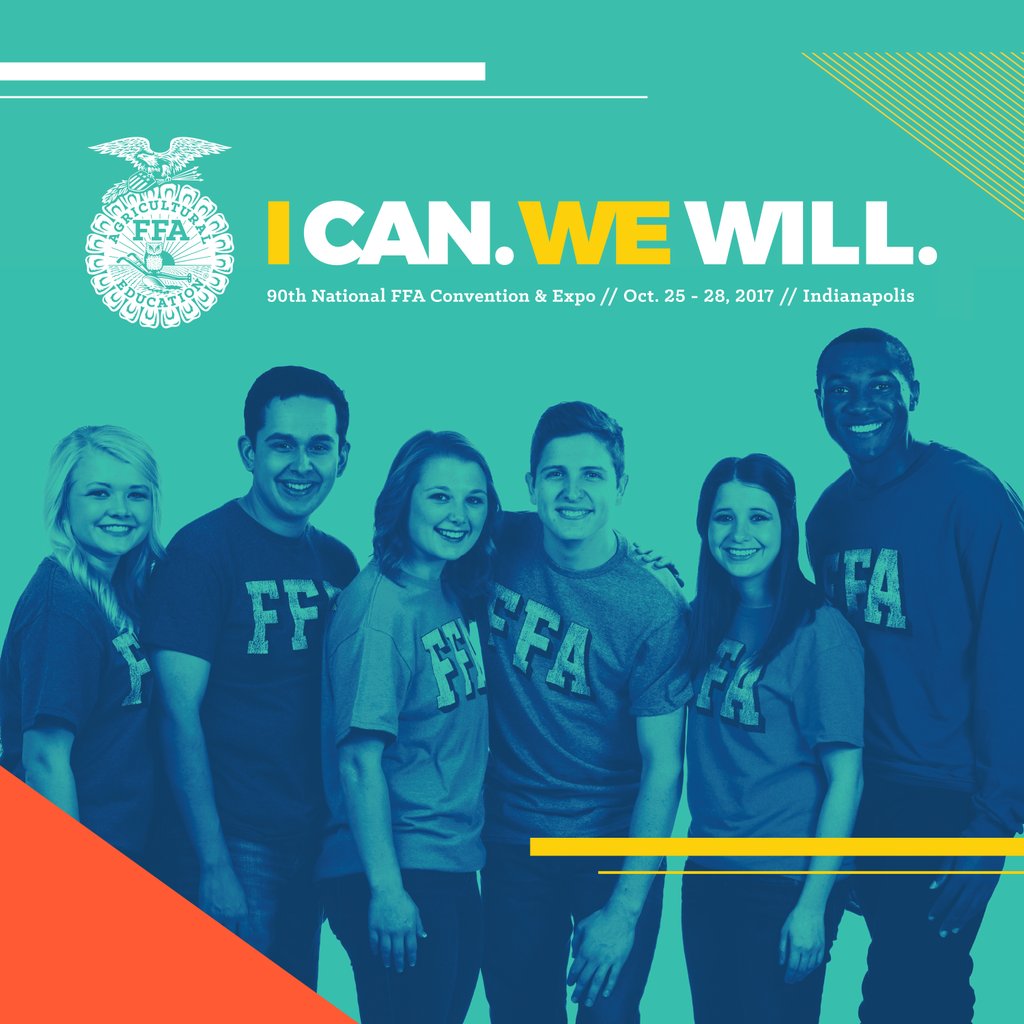
Big plans for National FFA
leadership candidates
By JAMIE SEARS RAWLINGS
Kentucky Correspondent
Indianapolis, In.— Candidates seeking leadership positions in the
National FFA Organization will soon begin a grueling 5-day interview process
where they will be vetted by their peers and then slated into one of only six
offices that will put them at the head of 649,355 FFA members nationwide.
Forty-one candidates from across the nation will vie for two
at-large positions (President and Secretary) and four regional vice president
positions during eight different interviews in two phases of selection. Once
those are complete, the 9-member selection committee will recommend the
organization’s new officers, which will then be approved by membership during
the 90th National FFA Convention & Expo, held in Indianapolis October
25-28.
Grueling as the selection may be, some candidates realize the
benefits of the process.
“I’m at peace with the process,” said Erica Baier of the Earlham
Chapter in Iowa.
“It’s just an amazing process for personal growth and
understanding who you are and why you truly do what you do.”
Fellow candidate Kade Hill, who represented his home state of
Illinois as a candidate for national office last year and is back for the same
chance again this year, also believes there is much to be learned from the
selection interviews.
“Having gone through this process previously, I do understand
that the most important part is staying true to who I am as an individual and
representing that to the committee,” Hill said.
“As long as I do that, selected or not, I’ll feel successful in
the process.”
Reflecting a recent focus for the National FFA organization, the
candidate’s goals for national office if selected are very diverse.
“Throughout this candidacy process, I’ve learned more and more
about redirecting attention back to members,” said Chelsea Sanders of the
Wilson Central chapter in Tennessee.
“If elected, I would continue to create support for members
across the country and to create a place where they can consider home.”
Annalee Witte of the Eastern Hancock chapter, also plans to focus
on membership if she is selected for national office.
“My goals would be to represent students past, present and
future,” she said, citing the importance of working to keep alumni engaged in
the organization, taking the time to connect with current members and focusing
on the security of the organization for future members.
If selected for National Office, Michigan’s candidate Loren King
would like to focus on ways to broaden the organization’s membership.
“One of my main goals is to validate the idea of using STEM
(science, technology, engineering and math) in agriculture,” King said.
“In my county alone, we have a population that is 40 percent
middle eastern and they find great engagement in our math classes, engineering
and calculus classes at our career center, but they don’t recognize agriculture
as a class where they can also gain that experience or pursue something like a
personal business through a supervised agriculture experience.”
“I really want to help us develop programs that make technology
something that’s viable and that would appeal to someone outside of agriculture
and increase our membership across all FFA chapters.”
Hill, of the Paxton-Buckley-Loda chapter, has even a different
focus for his possible future as a national officer.
“I am focused a lot on diversity,” the University of Illinois
agriculture education major said.
“That’s a big focus within the National FFA Organization and, specifically,
this convention, they are focusing on diversity and inclusiveness.”
“My goal for my year as a national officer, if elected, is to
create programs to highlight members and chapters that go out of their way to
represent inclusiveness and diversity within our organization.”
Regardless of whether or not they are chosen to help lead the
organization into the future, many of the candidates recognize the impact that
their membership has had already on their lives and will have for their
personal futures in the agriculture industry.
Witte, currently a sophomore at Purdue University studying
agriculture economics with a concentration in sales and marketing, believes
that her involvement in FFA will help secure her future success in the
agriculture field.
“Besides giving me a really strong technical background in
agriculture, agriculture is all about people skills, and FFA gives you the
people skills that you need to succeed,” she said.
“FFA is an extremely powerful tool when you’re talking about going
into the workforce because it’s so recognizable and because the skills really
do translate into exactly what you’re going to be doing.”
“The exposure that I’ve had to the industry through the FFA
organization has really built an ability to communicate and an ability to
communicate effectively and so without the National FFA Organization, I
definitely feel like I would not be as comfortable looking at my future the way
that I am now,” echoed Sanders, who is currently studying agriculture
communications at Tennessee Technological University.
Other regional candidates for National FFA Office include Mary
Buehler of the Anna chapter in Ohio and Gracie Furnish of the Harrison chapter
in Kentucky.
|