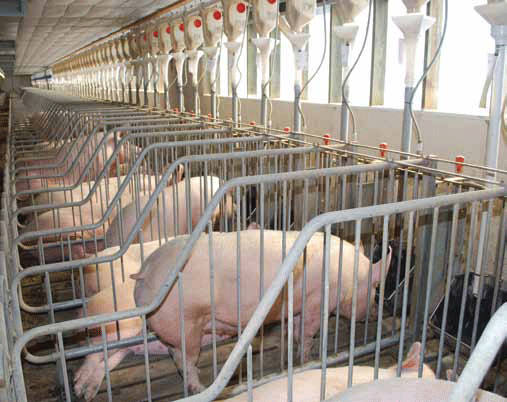
Illinois study: Group housing and
rank affect sow gestation
By TIM ALEXANDER
Illinois Correspondent
URBANA, Ill. — As 11 states and some large pork producers,
responding to consumer demand, move away from swine gestation crates, a new
study confirms producers’ perception that group housing can adversely affect
reproductive performance.
However, hurdles to maximum reproduction can be overcome with
proper management, according to a University of Illinois animal health expert
and a respected Illinois pork producer who did not contribute to the study.
“Reproductive performance has always been a metric that people
have been concerned with about housing,” said Janeen Salak-Johnson, U of I
associate professor in the Department of Animal Sciences.
She noted most previous research suggests approximate
reproductive performance in group housing versus individual stalls, although
most producers report diminished reproduction in group environments. Sows are
often placed in group housing after pregnancy, where adverse effects can
include low birth weight piglets or fewer piglets, rather than an impaired
ability to attain or sustain pregnancy, Johnson concluded.
“That’s one of the big reasons people don’t see effects of group
housing on reproductive success – the sows are already pregnant,” she explained.
“But that doesn’t mean there aren’t potential effects on the litter during the
course of pregnancy.”
Johnson’s research suggests that differences in housing design,
size, feeding system and animal population can have a major impact on stress
levels affecting reproductive performance. Social rank and feed intake could be
the biggest stressors affecting swine reproductive performance in group
housing, according to the animal welfare expert.
“If dominant sows are not able to assert their dominance during
feeding by displacing submissive individuals, they get frustrated,” she said.
“That can lead to low birth weight piglets. Short feeding stalls offer some
level of protection, but also allow dominant sows to exhibit normal behavior.”
In an article published by Johnson, she recommends grouping sows
according to individual characteristics. “Maybe we start grouping them by body
weight, parity or speed of feed intake. Heavier sows eat much faster. Maybe put
them all together,” she said.
“You’re still going to have a dominant sow and a submissive sow,
but if you bring your composite groups closer together, I think you have an
opportunity to do a better job in reducing this variation that occurs in group
housing.”
Livestock producer Tim Maiers, founder of Maiers Ag Consulting in
west-central Illinois, agrees with Johnson’s assessment of factors affecting swine
reproduction in group environments.
“Gestation housing is something we have looked at as an industry
for many years,” said Maiers, who has held leadership roles with the Illinois
Pork Producers Assoc. “Whether stalls or group housing, both have their advantages
and disadvantages, and both systems can work for a producer. It comes down to
how producers manage those advantages or disadvantages.”
Social rank plays a major role in feed intake among gestating
sows, and finding the right balance can make the difference in providing the
production level producers are seeking, he explained. Sow aggression can be
strongest when pregnant animals are initially introduced in group settings.
“When you mix sows, there is going to be some fighting when
establishing their status in that pen. The timing of when to mix them is
(important), and so is the feeding system,” he added.
New, electronic feeding systems can mitigate competition and
stress. “With their ID tag, they get a certain amount of feed, and no other sow
can bother them or their feed. This lessens aggression during feeding time. The
feed is specified for body condition and rate of pregnancy.”
For producers without electronic, animal-specific feeding
systems, Maiers agrees that Johnson’s recommendation to basically hand-select
sows for open housing placement can be beneficial. “The less variety in age and
body type, and the way they eat, can make for a more consistent group and
hopefully cut down on some of that aggression,” he said.
“I don’t think there is one magic answer, but rather a
combination of things depending on the producer’s experience. Giving them new
ideas to consider, I think, is an important part of (Johnson’s) research and
gives producers new information to improve their farms and the condition and
welfare of their pigs.”
In addition to raising pigs with his uncle, Maiers is active in
cow-calf production. In his business role with Maiers Ag Consulting, he is
working with the Illinois Livestock Development Group to promote and expand the
industry. He is also working with a new coalition of Illinois farm groups who
are educating producers about EPA regulations for large livestock barns.
Johnson’s article, “Social Status and Housing Factors Affect
Reproductive Performance of Pregnant Sows in Groups,” is published in Molecular Reproduction and Development.
It was supported by a National Pork Board grant.
|