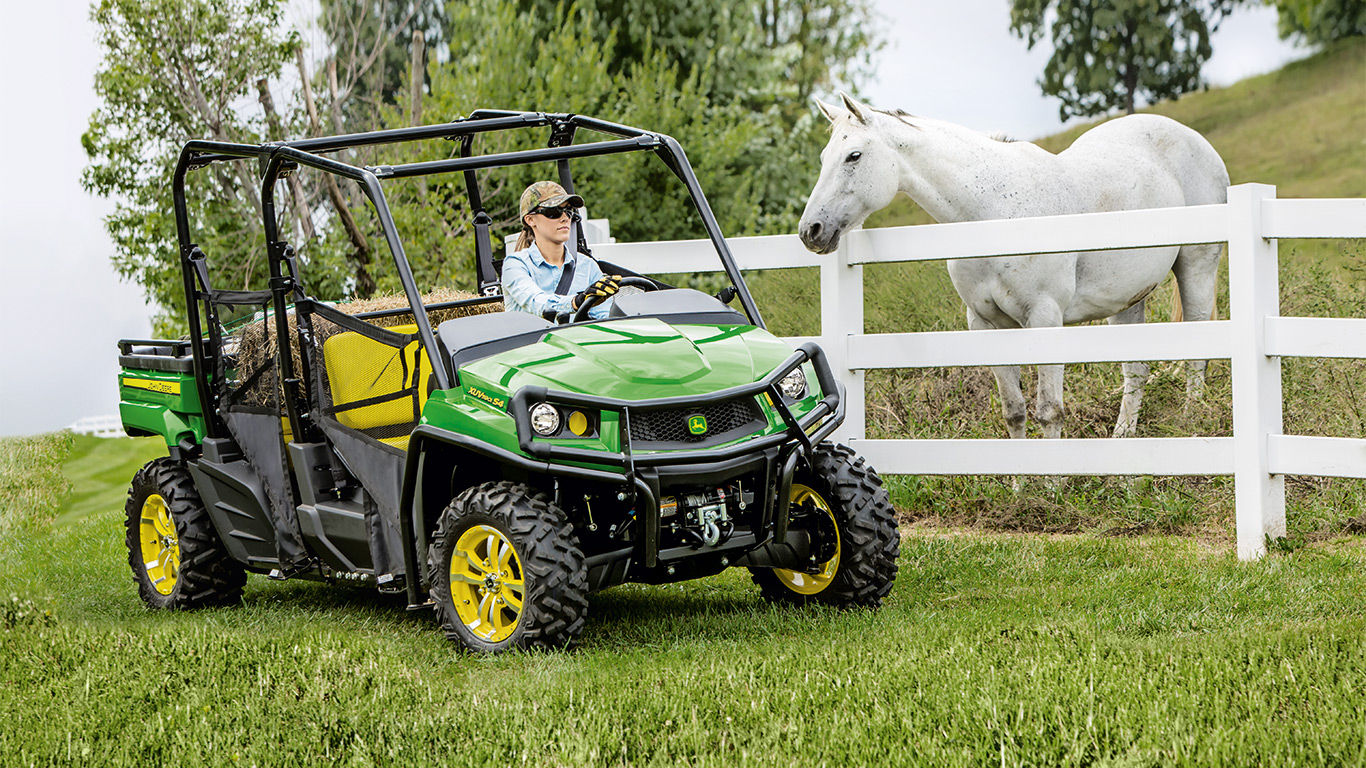
New Ohio law allows utility vehicles to share
the road
By DOUG GRAVES
Ohio Correspondent
COLUMBUS, Ohio — It’s harvest season and most rural residents
know they’ll be confronted with slow-moving tractors and combines as farmers trek
from one field to another.
There is another group of farm vehicles (permitted by law) to
traverse Ohio country roads – utility vehicles. A new state law went into
effect this summer, allowing certain utility vehicles (including Gators, Mules
and others with a bed designed to transport cargo) to share the open road.
The new law is part of the 2018-19 transportation budget,
formally known as state House Bill 26. It permits vehicles in Ohio to travel on
any public road or right-of-way (other than a freeway) when going from one farm
field to another, for agricultural purposes.
“During harvest season there is an increased traffic flow on
rural roads with agricultural implements and grain trucks,” said Dee Jepsen,
Ohio State University extension safety specialist. “Now there are utility
vehicles. Understanding these new rules of the road is a shared responsibility
between the farm machinery operators and the motoring public.”
A utility vehicle is one designed with a bed, for transporting
material or cargo related to agricultural activities. A 2009 law required
registration for APVs (all purpose vehicles) and ATVs, defined as
“self-propelled vehicles designed primarily for cross-country travel.” But the
law exempted APVs and ATVs used for farming.
As long as the utility vehicle is used primarily for agricultural
purposes and the owner qualifies for current agricultural use valuation (CAUV),
it does not require registration or a license.
Under H.B. 26, utility vehicles are now required to display a
triangular slow-moving vehicle (SMV) emblem. Previously, it was up to local law
enforcement to interpret the law and decide whether a utility vehicle should
have an emblem, and required farmers to know whether the county or township
allowed utility vehicles on the road.
“There are three things to keep in mind before one drives a
utility vehicle on the road,” Jepsen said. “First, in order to use it on a
public road, a driver must be traveling from one field to another for
agricultural purposes. Second, drivers must display an SMV emblem on any
utility vehicle used on a public road as it travels between farm fields.
“Finally, the Ohio Revised Code prohibits the placement of earth,
mud, manure or other materials on a public highway, so if your tractor or
utility vehicle leaves such debris or mud in the roadway, you’d better clean it
up.”
According to her, a farmer may drive a utility vehicle on the
berm or shoulder of a roadway if the terrain permits such operation to be
undertaken safety and without entering a traffic lane.
“If the farmer cannot operate on the berm without entering a
traffic lane, the farmer should operate entirely on the roadway,” she noted.
Jepsen said a child who does not legally hold a driver’s license
may not operate the utility vehicle on a roadway or any portion of the
right-of-way. A child under 16 may operate a utility vehicle on their family’s
farm, and may also operate on another’s farm or private property if accompanied
by a person who is at least 18 and holds a driver’s license.
|