Illinois
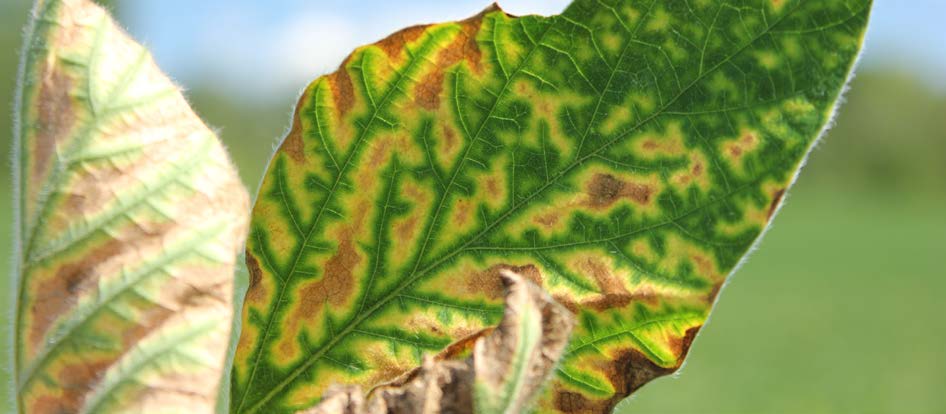
researcher zeroing in on soil condition and soybean SDS
By STEVE BINDER
Illinois Correspondent
CARBONDALE, Ill. — A Southern Illinois University Carbondale
researcher has developed timely new evidence to a long-known hypothesis: Soil
condition could hold the key to combating sudden death syndrome (SDS).
Ahmad Fakhoury, an associated professor of plant pathology and
fungal genetics, details his theory in an article published recently in Phytobiomes, a journal of The American
Phytopathological Society.
As growers know, SDS can wipe out whole fields of soybeans if
left untreated, and for Illinois – the top-producing bean state for the past
two years – the crop is big business, hitting nearly $6 billion in direct sales
last year.
Fakhoury said his research zeros in on the condition of soil as
an attack point to combating the disease. “The occurrence of SDS in fields is
dependent on physical and biological factors, and the suppressiveness of soils
to disease is a long-known phenomenon,” he explained.
“Promoting and sustaining the soil’s natural suppressiveness to
disease can be integral to the effective, sustainable management of soilborne
pathogens.”
Soil profiling has been a key tool for researchers studying SDS,
but most work has focused on identifying the soil’s physical and chemical
characteristics when SDS is present. Fakhoury found a new way to analyze soil
to determine the incidence and severity of SDS by profiling the soil’s microbes
as well as its physical and chemical properties.
In Fakhoury’s study, soil samples from 45 soybean fields in
Illinois, Iowa and Minnesota were analyzed. Researchers collected samples from
fields showing symptoms of SDS and from adjacent areas where SDS foliar
symptoms did not develop.
Fakhoury compared microbial populations in the “healthy” and
“diseased” soil to correlate the presence incidence and severity of SDS, then
measured soil-related factors and used markers specific to bacteria, fungi,
archaea, oomycetes and nematodes to help identify key taxonomic species
associated with SDS development.
He generated more than 14 million sequences and mapped them
against the National Center for Biotechnology Information’s nucleotide database,
and compared them using several bioinformatics tools.
The unique method of analysis found significant differences in
the bacterial and fungal structures between healthy and diseased areas of
fields, suggesting the relative abundance of multiple microbial taxia in the
soil as a key determinant in the incidence of SDS, Fakhoury explained.
“The work … documents the first attempt to assess the importance
of biological factors in determining the incidence of SDS in soybean using
metagenomics tools,” he noted. “This is basically a first attempt at resolving
the complexity of the biological interactions that affect the occurrence of the
disease.”
The yearlong project will lead to further research to
characterize the main fungal pathogen associated with SDS – and likely lead to
ways of addressing soil conditions in ways that limit or prevent the start of
SDS.
“The emerging tools and techniques we used permit the
differentiation of complex microbial interactions,” Fakhoury added. “This will
ultimately allow us to devise and adopt more efficient and sustainable
strategies to manage SDS and other diseases that are detrimental to
agricultural production.”
His research can be viewed at www.phytobiomesjournal.org
|